
Real Photos vs. AI Images: Why Your Social Media Needs Fewer Robots and More Real People
November 23, 2026 // 11 min read
TABLE OF CONTENTS
- What You’ll Learn
- What Is Meta Actually Doing With AI Images?
- Is the AI Label Actually the Problem?
- Can’t We Just Remove the Metadata?
- So Is AI Off-Limits Now?
- What Can Real Photos Do That AI Can’t?
- How Do You Build a Real Photo Library (Without Losing Your Mind)?
- How Do You Make Great Graphics Without AI-Generated Images?
- Frequently Asked Questions

It’s Wednesday afternoon. Thursday’s post needs a graphic. You have no photos, four minutes, and an AI image generator open in another tab.
Thirty seconds later, you have a beautifully lit group of smiling people who have never existed. Problem solved. Cool.
Then Meta adds a little “AI info” label to your post.
Now your followers have a question you didn’t plan for: If that isn’t real, what else isn’t?
AI image tools are fast, cheap, and (we’ll admit it) pretty impressive. But on social media, every image you post is either building trust or spending it. And the most reliable way to stay on the right side of that line isn’t a better prompt. It’s a real photo of a real person doing a real thing.
What you’ll learn in this article:
- What Meta is actually doing with AI labels (and what it isn’t).
- Why the label is a symptom, not the real problem.
- Where AI belongs in your visual strategy, and where it doesn’t.
- How to build a real photo library without hiring a full-time photographer.
What Is Meta Actually Doing With AI Images?
Let’s clear up the rumors first. (No, Instagram is not secretly punishing everyone who’s ever opened ChatGPT.)
Across Facebook, Instagram, and Threads, Meta adds an “AI info” label to content it identifies as created or edited with AI. It figures that out two ways:
- Hidden signals. Many AI tools, including ones from Adobe, Google, OpenAI, Midjourney, and Shutterstock, tag the images they create with invisible metadata. Think of it as a digital fingerprint. Meta reads it.
- Self-disclosure. Creators can label their own content as AI, and in some situations, they’re expected to.
Ads aren’t exempt, either. When Meta detects that an ad was created or significantly edited with generative AI, an “AI info” disclosure shows up under “About this ad.”
→ Here’s the part almost everyone misses: real photos get labeled, too.
When Meta first rolled out its labels, professional photographers started finding “Made with AI” on photos they had actually taken. Their crime? Using AI-powered editing tools to remove a stray sign or stretch a background. The metadata couldn’t tell “made by AI” from “touched up by AI.” Meta softened the wording to “AI info” after the backlash, but the lesson stuck around: if AI touched the image, the image might tell on you.
So when we say “use real photos,” we mean real all the way through. A real photo with an AI-generated sky is still, technically, an AI image.
Is the AI Label Actually the Problem?
Plot twist: not really.
Meta hasn’t said the label hurts your reach, and we’re not going to invent a scary statistic to make this article more exciting. The label is a few words in the corner of a post. What matters is what those words confirm for your audience.
→ People can usually tell.
AI images have a look. The lighting is a little too perfect. The skin is a little too smooth. Somebody in the back row has six fingers and no visible feet. Your audience is getting very good at spotting it, and when they do, the label just says out loud what they were already thinking.
→ Trust is the whole job.
For a church, nonprofit, or local business, social media isn’t a contest for the prettiest image in the feed. It’s a preview. It shows people who you are, so when they finally walk through your doors, the place and the people already feel familiar.
Now picture a family visiting your church for the first time because of a photo of a packed, joyful kids’ ministry. Then they find out the photo was generated. You didn’t just lose a follower. You taught them to doubt the next thing you say.
→ Average in, average out.
AI builds images from patterns in millions of other images. Translation: it’s really, really good at average. When every organization uses the same tools to generate the same polished, vaguely familiar people, nobody stands out.
Your actual volunteers, your actual building, your actual Tuesday afternoon? Nobody else has those. That’s your competitive advantage, and it’s probably sitting in someone’s camera roll right now.
The label isn’t the problem. It’s a flashlight pointing at it.
Can’t We Just Remove the Metadata?
We hear this one. Often. Usually with a slightly mischievous grin.
Yes, there are ways to strip the hidden data off an image so Meta’s detection misses it. But zoom out on what’s actually happening: you’d be hiding that something isn’t real from the exact people you’re trying to earn trust with. That’s not a workaround. That’s the original problem with extra steps.
Expectations around AI transparency are only moving in one direction. A visual strategy built on “hopefully nobody notices” isn’t a strategy. It’s a countdown.
So Is AI Off-Limits Now?
Nope. At TwoTone, we help organizations use AI every day (it’s literally one of our services), so we’re not about to tell you to chuck it out the window. The question isn’t whether to use AI. It’s where.
→ Where AI earns its keep
- Brainstorming concepts and layouts before a shoot.
- Building mood boards and creative direction.
- Drafting captions that a human then edits (please, edit them).
- Resizing and reformatting assets you already have.
- Internal mockups that never leave the building.
→ Where real photos win, every time
- Anything representing your people, your place, or your community.
- Testimonials, stories, and impact content.
- Events, services, and behind-the-scenes moments.
- Anything someone might use to decide whether to trust you.
Our rule of thumb: if an image makes a claim about who you are or what happens at your organization, it needs to be real. If it’s helping you get to the real thing faster, AI can pull up a chair.
What Can Real Photos Do That AI Can’t?
Avoiding a label is the floor, not the ceiling. Real photography does things AI simply can’t fake.
- It builds recognition. When followers see the same faces week after week (your pastor, your front-desk crew, the volunteer who’s always at the coffee bar), they start to feel like they know you. Familiarity turns into visits, calls, and donations.
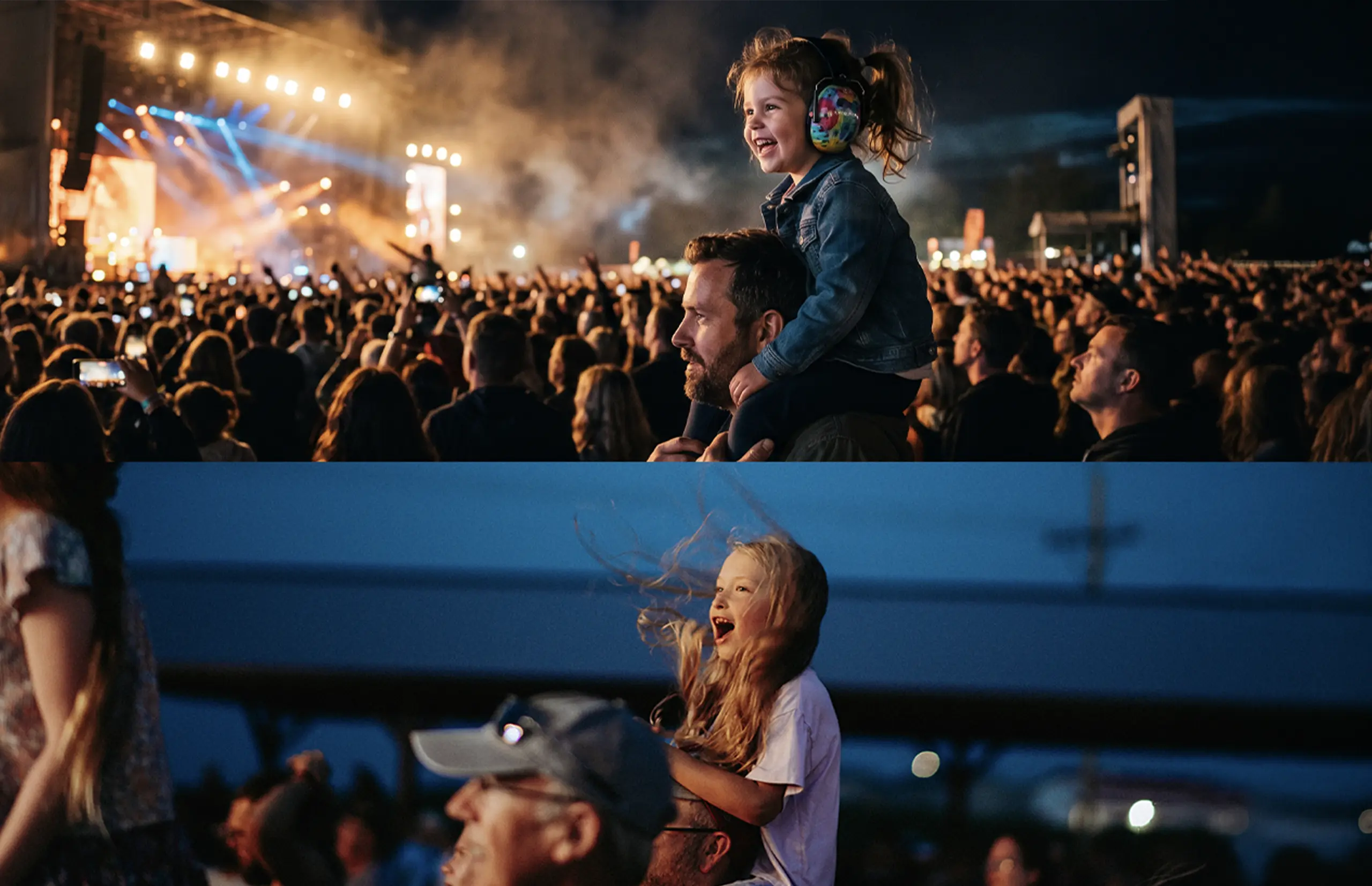
- It tells true stories. The baptism. The family that got a new roof before the first snow. The volunteer team that showed up at 6 a.m. on a Saturday. That’s your best content, and it only exists in real photos.
- It’s proof. For people who find you online first, authentic photos are evidence: the place exists, the people are friendly, and the experience matches the promise.
- It ages well. Today’s trendy AI aesthetic is going to look very “2026” very soon. A great photo of real people is just a great photo.
How Do You Build a Real Photo Library (Without Losing Your Mind)?
Let’s be honest about why most teams reach for AI in the first place: there aren’t any good photos. Or there are, but they’re from 2019, buried in someone’s phone, or living in a folder called “Misc FINAL (2).” Totally fixable.
- Book a professional shoot once or twice a year. This is where your hero images come from: website banners, key initiatives, leadership headshots, and the polished shots you’ll use again and again. One well-planned shoot can fuel months of content.
- Make everyday photos somebody’s job. Phones take great photos now. The problem usually isn’t the equipment. It’s that “someone should grab a picture” really means no one will. Assign a staff member or trusted volunteer, hand them a simple shot list, and give them full permission to be that person with the camera.
- Get permission. Use photo releases where appropriate, especially for minors, clients, or anyone front and center. Five minutes now saves an awkward conversation later.
- Organize it like you actually plan to use it. A library nobody can search is just a pile. Sort by people, place, events, seasons, and staff so whoever’s posting can find the right shot in minutes, not after an hour of scrolling.
- Keep it fresh. If your followers have seen the same five photos for two years, trust us, they’ve noticed. Plan new content every quarter so your feed looks like who you are now, not who you were then.
How Do You Make Great Graphics Without AI-Generated Images?
Real photos and strong design aren’t rivals. They’re teammates.
- Build branded templates. Pair real photos with consistent text overlays, color blocks, and logo placement so every post is unmistakably yours.
- Skip the generative features. AI fill, AI expand, and similar tools are the most common way real photos end up with a label. Crop, adjust, and design instead.
- Know your tools. Some editing and design platforms add AI metadata when you use certain features. Know which ones before you hit export.
- Use stock sparingly. Traditional stock photos won’t trigger the label, but a growing share of stock libraries are AI-generated, so check. Either way, stock is generic. Let it support your story, not star in it.
Frequently Asked Questions
Does Meta label AI-generated images on Facebook and Instagram?
Yes. Meta adds an “AI info” label to content it detects as created or edited with AI, using industry-standard metadata and creator self-disclosure. Ads made or significantly edited with generative AI get a similar disclosure in “About this ad.”
Can a real photo get an AI label?
Yep. If you edit a real photo with generative AI features, like filling in or extending a background, it may carry metadata that triggers the label.
Does the AI label hurt my reach?
Meta hasn’t said it does. The bigger risk is how your audience responds when they realize an image isn’t real.
Should we stop using AI for social media altogether?
Nope. AI is useful for brainstorming, drafting, and mockups. Any image representing your people, place, or impact should be real.
Are stock photos better than AI images?
For avoiding the label, usually. For building trust, they’re still generic. Real photos of your organization beat both.
We don’t have good photos. Where do we start?
Book one professional shoot to build a core library, then assign someone to capture everyday moments on a phone. Organize it all in a shared folder so it actually gets used.
Is it okay to remove AI metadata from an image?
Technically possible. Strategically, a bad idea. Hiding that an image isn’t real undermines the trust you’re trying to build.
Don’t Generate Your Story. Show It.
AI can make an image in seconds. It can’t make your organization look like itself.
The people scrolling past your posts want to know who you really are. The ones who eventually walk through your doors will notice if it doesn’t match.
At TwoTone, we help organizations build visual strategies that are fast and authentic: professional photo and video shoots, branded social templates, and content plans that make real photos easy to use week after week. And yes, we’ll help you figure out where AI genuinely saves time, without costing you trust.
Real people. Real places. Real trust.
If your feed needs a little more real and a lot less rendered, let’s talk.
READ NEXT
Post-Christmas Playbook: How to Follow Up with First-Time Church Visitors
2026 TwoTone Holiday Gift Guide
What We Built in 2026: Websites, Branding, Video, and More Remarkable Work
SEO Starter Guide
AI Marketing Prompts: 20 Questions to Ask AI About Your Organization
TwoTone Reads 2026: Leadership Books Worth Reading